Narration Generation for Cartoon Videos: Task Formalization, Dataset, and Models
A research paper introducing the task of automatic narration generation for videos, presenting a new dataset from Peppa Pig, and proposing models for timing and content generation.
Home »
Documentation »
Narration Generation for Cartoon Videos: Task Formalization, Dataset, and Models
1. Introduction & Task Definition
This paper introduces Narration Generation, a novel task in multimodal AI that involves automatically generating contextual, story-contributing narration text to be interjected at specific points within a video. Unlike traditional video captioning or description, which aims to describe visible content, narration provides high-level, context-informed commentary that advances the storyline, fills in non-visible details, and guides the viewer. The task is distinct in that the generated text becomes an integral part of the video experience, requiring temporal reasoning and an understanding of narrative arcs.
The authors position this task as a more challenging successor to image captioning and video description, necessitating models that can reason about temporal context and infer story progression beyond mere visual grounding.
2. The Peppa Pig Narration Dataset
To enable research, the authors created a new dataset sourced from the animated television series Peppa Pig. This choice is strategic: cartoon videos abstract away the complexities of real-world visuals and adult dialogue, allowing for a cleaner evaluation of the core text generation and timing challenges.
Dataset Snapshot
Source:Peppa Pig animated series.
Content: Video clips paired with subtitle dialogues and corresponding narrator lines.
Key Feature: Narrations are not mere descriptions; they provide story context, character insight, or parallel commentary.
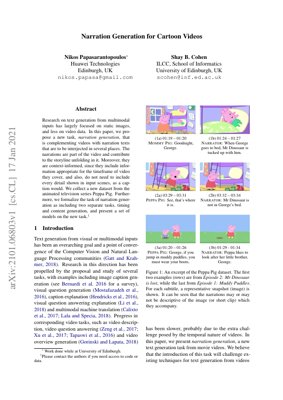
The dataset includes examples where the narration directly describes the scene (e.g., "Mr Dinosaur is tucked up with him") and others where it provides external story context (e.g., "Peppa likes to look after her little brother, George"), highlighting the task's complexity.
3. Task Formalization & Methodology
The authors decompose the narration generation problem into two core sub-tasks:
3.1. The Timing Task
Determining when a narration should be inserted. This involves analyzing the video's temporal flow, dialogue pauses, and scene transitions to identify natural breakpoints for narrative interjection. The model must predict the start and end timestamps for a narration segment.
3.2. The Content Generation Task
Generating what the narration should say. Given a video segment and its contextual dialogue, the model must produce coherent, context-appropriate text that contributes to the story. This requires a fusion of visual features (from the video frames), textual features (from character dialogue), and temporal context.
4. Proposed Models & Architecture
The paper presents a suite of models tackling the dual tasks. Architectures likely involve multimodal encoders (e.g., CNN for video frames, RNN or Transformer for subtitles) followed by task-specific decoders.
Technical Detail (Mathematical Formulation): A core challenge is aligning multimodal sequences. Let $V = \{v_1, v_2, ..., v_T\}$ represent a sequence of visual features (e.g., from a 3D CNN like I3D) and $S = \{s_1, s_2, ..., s_M\}$ represent the sequence of subtitle dialogue embeddings. The timing model learns a function $f_{time}$ to predict a probability distribution over time for narration insertion: $P(t_{start}, t_{end} | V, S)$. The content generation model, conditioned on the chosen segment $(V_{[t_{start}:t_{end}]}, S_{context})$, learns a language model $f_{text}$ to generate the narration sequence $N = \{n_1, n_2, ..., n_L\}$, often optimized via a cross-entropy loss: $\mathcal{L}_{gen} = -\sum_{i=1}^{L} \log P(n_i | n_{
This formulation mirrors advancements in sequence-to-sequence models for video captioning but adds the critical layer of cross-modal temporal grounding for timing.
5. Experimental Results & Chart Explanation
While the provided PDF excerpt does not show specific numerical results, it implies evaluation through standard NLP metrics like BLEU, ROUGE, and METEOR for content quality, and precision/recall of predicted timestamps against ground truth for timing accuracy.
Implied Evaluation Framework
Content Generation Metrics: BLEU-n, ROUGE-L, METEOR. These measure n-gram overlap and semantic similarity between generated narrations and human-written references.
Timing Task Metrics: Temporal IoU (Intersection over Union), Precision/Recall at a threshold (e.g., if predicted segment overlaps with ground truth by >0.5).
Human Evaluation: Likely includes ratings for coherence, relevance, and storytelling contribution, which are crucial for a subjective task like narration.
The key finding would be that jointly modeling timing and content, or using a pipeline that first identifies timing and then generates content for that segment, outperforms naive approaches that treat the entire video as a single input for text generation.
6. Analysis Framework & Case Study
Framework for Evaluating Narration Quality:
Temporal Coherence: Does the narration appear at a logical story beat (e.g., after a key event, during a lull in action)?
Contextual Relevance: Does it reference elements from the immediate past or foreshadow future events?
Narrative Value-Add: Does it provide information not obvious from the visuals/dialogue (character thought, backstory, causal link)?
Linguistic Style: Does it match the tone of the source material (e.g., the simple, explanatory style of a children's show narrator)?
Case Study (Based on Figure 1): Input: Video clip of George going to bed, dialogue: "Goodnight, George." Weak Output (Descriptive Caption): "A pig is in a bed with a toy." Strong Output (Contextual Narration): "When George goes to bed, Mr Dinosaur is tucked up with him."
The strong output passes the framework: it's temporally coherent (after the goodnight), adds narrative value (establishes a routine/habit), and uses appropriate style.
7. Future Applications & Research Directions
Accessibility Tools: Automatic audio descriptions for the visually impaired that are more narrative and engaging than simple scene descriptions.
Content Localization & Dubbing: Generating culturally adapted narrations for different regions, going beyond direct translation.
Interactive Storytelling & Gaming: Dynamic narration that reacts to player choices or viewer engagement in interactive media.
Educational Video Enhancement: Adding explanatory or summarizing narration to instructional videos to improve comprehension.
Research Directions: Scaling to complex, live-action films with nuanced dialogue; integrating commonsense and world knowledge (e.g., using models like COMET); exploring controllable generation (e.g., generate a humorous vs. serious narration).
8. References
Bernardi, R., et al. (2016). Automatic Description Generation from Images: A Survey of Models, Datasets, and Evaluation Measures. JAIR.
Gatt, A., & Krahmer, E. (2018). Survey of the State of the Art in Natural Language Generation: Core tasks, applications and evaluation. Journal of Artificial Intelligence Research.
Hendricks, L. A., et al. (2016). Generating Visual Explanations. ECCV.
Kim, K., et al. (2016). Story-oriented Visual Question Answering in TV Show. CVPR Workshop.
Zhu, J., et al. (2017). Unpaired Image-to-Image Translation using Cycle-Consistent Adversarial Networks. ICCV. (CycleGAN - for style/domain adaptation in visual features).
Vaswani, A., et al. (2017). Attention Is All You Need. NeurIPS. (Transformer architecture foundational to modern text generation).
OpenAI. (2023). GPT-4 Technical Report. (Represents the state-of-the-art in large language models relevant for the content generation component).
9. Expert Analysis & Critical Review
Core Insight: Papasarantopoulos and Cohen aren't just proposing another multimodal task; they're attempting to formalize narrative intelligence for machines. The real breakthrough here is the explicit decoupling of "timing" and "content"—a recognition that generating story-relevant text is meaningless if delivered at the wrong dramatic beat. This moves beyond the frame-by-frame descriptive paradigm of classic video captioning (e.g., MSR-VTT, ActivityNet Captions) into the realm of directorial intent. By choosing Peppa Pig, they make a savvy, if defensive, move. It isolates the narrative structure problem from the still-unsolved mess of real-world visual understanding, much like how early machine translation research used curated news text. However, this also creates a potential "cartoon gap"—will techniques that learn the simple cause-and-effect logic of a children's show generalize to the moral ambiguity of a Scorsese film?
Logical Flow & Technical Contribution: The paper's logic is sound: define a new task, create a clean dataset, decompose the problem, and propose baseline models. The technical contribution is primarily in the task definition and dataset creation. The implied model architectures—likely multimodal encoders with attention mechanisms over time—are standard for the 2021 timeframe, drawing heavily from the video-and-language tradition established by works like Xu et al.'s (2017) S2VT. The true innovation is the framing. The mathematical formulation of the timing task as a segment prediction problem ($P(t_{start}, t_{end} | V, S)$) is a direct application of temporal action localization techniques from video analysis to a language-centric problem.
Strengths & Flaws: The major strength is focus. The paper carves out a distinct, valuable, and well-defined niche. The dataset, while narrow, is high-quality for its purpose. The flaw is in what's left for the future: the elephant in the room is evaluation. Metrics like BLEU are notoriously poor at capturing narrative cohesion or cleverness. The paper hints at human evaluation, but long-term success depends on developing automated metrics that assess storytelling quality, perhaps inspired by recent work on factual consistency or discourse coherence in NLP. Furthermore, the two-stage pipeline (timing then content) risks error propagation; an end-to-end model that jointly reasons about "when" and "what" might be more robust, as seen in later unified architectures like Google's Flamingo or Microsoft's Kosmos-1.
Actionable Insights: For researchers, the immediate path is to benchmark advanced architectures (Vision-Language Transformers, diffusion models for text) on this new Peppa Pig dataset. For industry, the near-term application isn't in Hollywood but in scalable content repurposing. Imagine a platform that can automatically generate "story recaps" for educational videos or create accessible narrations for user-generated content at scale. The strategic move is to treat this not as a fully autonomous director, but as a powerful authoring tool—a "narrative assistant" that suggests narration points and drafts text for a human editor to refine. The next step should be to integrate external knowledge bases (à la Google's REALM or Facebook's RAG models) to allow narrations to incorporate relevant facts, making the output truly insightful rather than just coherent.