1. Introduction
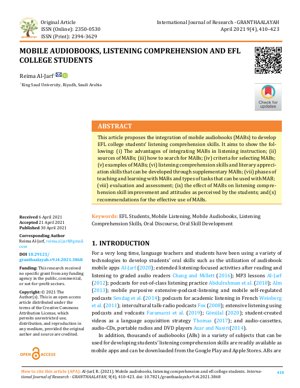
This article proposes a framework for integrating Mobile Audiobooks (MABs) to develop English as a Foreign Language (EFL) college students' listening comprehension skills. It builds upon a history of using various audio technologies—from audiocassettes to podcasts—in language instruction. The proliferation of smartphones and accessible audiobook platforms presents a new, potent tool for immersive and flexible listening practice outside the classroom.
2. Advantages of Mobile Audiobooks (MABs)
MABs offer distinct advantages for EFL learners:
- Accessibility & Portability: Available on-demand via mobile apps, allowing learning anytime, anywhere.
- Authentic Input: Provide exposure to professional narration, varied accents, and natural oral discourse.
- Multimodal Support: Available in audio-only, audio-with-text, and video formats, catering to different learning preferences.
- Motivational: Engaging content (e.g., stories, non-fiction) can increase student motivation and time spent on task.
- Scaffolding for Difficulty: Make complex texts accessible by bypassing decoding barriers, allowing focus on comprehension.
3. Sourcing and Selecting MABs
A strategic approach to finding and choosing appropriate MABs is crucial.
3.1 Sources of MABs
Primary sources include official app stores (Google Play, Apple App Store), dedicated audiobook platforms (Audible, Storytel), educational websites, and library services. A vast array of content in multiple languages and for all age groups is available.
3.2 Search Strategies
Effective searching involves using specific keywords related to language level (e.g., "graded reader," "B1"), genre, topic, and narrator. Filtering by duration, publication date, and user ratings can refine results.
3.3 Selection Criteria
Key criteria for selecting pedagogically sound MABs include:
- Linguistic Appropriateness: Aligns with students' proficiency level (CEFR guidelines are useful).
- Content Relevance: Matches curricular goals or student interests.
- Narration Quality: Clear pronunciation, appropriate pace, and expressive delivery.
- Technical Features: Availability of playback controls (speed adjustment, bookmarks).
- Supporting Materials: Presence of synchronized text or supplementary activities.
3.4 Example MABs
The article suggests exploring graded readers from publishers like Penguin, Oxford, or Cambridge, as well as simplified versions of classic literature and non-fiction titles relevant to academic disciplines.
4. Skills Development Framework
MABs can be used to develop a dual set of skills.
4.1 Listening Comprehension Skills
- Bottom-up processing: Discriminating sounds, recognizing words in connected speech.
- Top-down processing: Using context and prior knowledge to infer meaning.
- Listening for gist, specific information, and detailed comprehension.
- Understanding discourse markers, intonation, and stress patterns.
4.2 Literary Appreciation Skills
- Identifying plot, setting, and character development.
- Appreciating narrative style, humor, and figurative language.
- Understanding cultural references and different dialects presented through voice acting.
5. Pedagogical Implementation
5.1 Teaching & Learning Phases
A structured approach is recommended:
- Pre-listening: Activate schema, pre-teach key vocabulary, set listening purposes.
- While-listening: Students engage with the MAB, completing guided tasks.
- Post-listening: Check comprehension, discuss content, extend learning through related activities (e.g., role-play, summary writing).
5.2 Task Types for MABs
- Global Understanding: Answering main idea questions, summarizing.
- Selective Listening: Information grids, true/false, multiple-choice on specific details.
- Interactive Tasks: Predicting what happens next, describing characters.
- Analytical Tasks: Analyzing the narrator's tone, comparing text vs. audio interpretation.
6. Evaluation & Assessment
Assessment should align with the targeted skills. This can include:
- Traditional quizzes on comprehension.
- Performance-based assessments like oral summaries or presentations based on the MAB content.
- Self-assessment and reflection journals where students track their listening progress and strategies.
- Portfolios of completed tasks related to different MABs.
7. Perceived Impact & Student Attitudes
The article posits that the use of MABs leads to measurable improvement in listening comprehension skills. Furthermore, it is anticipated to positively influence student attitudes towards listening practice, making it more enjoyable and autonomous. The mobile, on-demand nature reduces anxiety and increases engagement compared to traditional lab-based listening exercises.
8. Recommendations for Effective Use
- Integrate MABs as a supplementary tool, not a replacement for interactive speaking practice.
- Provide clear guidance on selection, goal-setting, and listening strategies.
- Blend individual MAB listening with collaborative in-class activities.
- Encourage extensive listening for pleasure alongside intensive, task-focused listening.
- Regularly update recommended MAB lists based on student feedback and new releases.
9. Core Analysis & Expert Insights
Core Insight: Al-Jarf's work is less a groundbreaking discovery and more a timely, systematic repackaging of established extensive listening principles for the smartphone era. Its real value lies in providing a concrete, actionable framework for a tool (audiobooks) that has been historically under-leveraged in formal EFL contexts at the tertiary level, often overshadowed by podcasts or video.
Logical Flow: The paper logically moves from justification (advantages, literature) to implementation (sourcing, pedagogy) and finally to validation (impact, recommendations). This practitioner-friendly flow is its strength, but it exposes a key weakness: the heavy reliance on perceived benefits and theoretical frameworks from prior studies on audiobooks in L1/younger learner contexts. There's a palpable gap where hard, experimental data on college-level EFL outcomes should be.
Strengths & Flaws: The framework's comprehensiveness is commendable—it answers the "how" for busy instructors. The focus on literary appreciation alongside comprehension is a nuanced plus. However, the analysis is critically flawed by the lack of original empirical evidence presented within the paper itself. Claims about "effect" and "improvement" are prospective, not demonstrated. Contrast this with a study like Chang & Millett (2016) in "System," which provided robust experimental data on graded audiobook efficacy, showing clear comprehension gains. Al-Jarf's piece is a proposal and a literature-informed guide, not a research report with results.
Actionable Insights: For educators, this is a ready-to-use blueprint. Start small: assign one short, high-interest graded audiobook per semester with structured pre-/post-tasks. Use the selection criteria to curate a list. For researchers, this paper highlights a ripe area for quantitative and qualitative study. Future work must isolate variables (e.g., with-text vs. audio-only, genre impact) and measure skill transfer using standardized instruments. The field needs less advocacy and more evidence on the specific cognitive and affective impacts of MABs on the adult EFL learner.
10. Technical Framework & Future Directions
Technical Details & Modeling: The pedagogical effectiveness of MABs can be conceptualized through a model of cognitive load and language acquisition. The listening process involves decoding an acoustic signal $A(t)$ into phonological units, which are then mapped to lexical items $L$ and integrated into a semantic representation $S$ using syntactic parsing $P$ and contextual knowledge $C$. This can be loosely represented as: $S = f(P(L(A(t))), C)$. MABs, especially with text support, can reduce the cognitive load of $A(t) \rightarrow L$ decoding, freeing resources for higher-order $S$ construction. Adaptive MAB systems could theoretically adjust speech rate $\frac{dA}{dt}$ or vocabulary complexity in real-time based on learner performance, optimizing the comprehensible input as defined by Krashen's $i+1$ principle.
Experimental Results & Charts: While the analyzed PDF does not present original data, a proposed experiment would measure pre- and post-test scores on a standardized listening exam (e.g., TOEFL iBT listening section) for a treatment group using MABs and a control group using traditional methods. The expected result, visualized in a bar chart, would show a statistically significant greater improvement ($\Delta \text{Score}_{MAB} > \Delta \text{Score}_{Control}$) for the MAB group. A second line chart could track weekly self-reported engagement metrics (minutes listened, enjoyment scale), hypothesizing a positive correlation with final score improvement.
Analysis Framework Example (Non-Code): An instructor can implement a simple A/B testing framework within a single class. Divide students into two cohorts. Cohort A follows the full MAB framework: selects a book using the provided criteria, engages in structured pre-while-post activities. Cohort B is simply asked to "listen to an English audiobook" without guidance. Compare outcomes via a common comprehension quiz on a shared story and a post-intervention survey on confidence and strategy use. This micro-experiment provides immediate, contextual feedback on the framework's value.
Future Applications & Directions: The future lies in intelligent, interactive MABs. Imagine platforms integrating AI that generates dynamic comprehension checks, automatically highlights transcripts in sync with audio, or provides instant vocabulary glossing. Personalized learning paths could be created based on listening habit analytics. Furthermore, social listening features—creating virtual book clubs where students can annotate, discuss, and voice-note about specific moments in the audiobook—could blend the benefits of extensive listening with collaborative learning. Research must explore the integration of MABs with immersive technologies (VR/AR) for scenario-based listening practice.
11. References
- Al-Jarf, R. (2021). Mobile Audiobooks, Listening Comprehension and EFL College Students. International Journal of Research - GRANTHAALAYAH, 9(4), 410-423.
- Chang, A. C., & Millett, S. (2016). Developing L2 listening fluency through extended extensive listening. Language Teaching Research, 20(6), 767–783.
- Krashen, S. D. (1985). The Input Hypothesis: Issues and Implications. Longman.
- Vandergrift, L., & Goh, C. C. M. (2012). Teaching and Learning Second Language Listening: Metacognition in Action. Routledge.
- Zhu, J., Park, T., Isola, P., & Efros, A. A. (2017). Unpaired Image-to-Image Translation using Cycle-Consistent Adversarial Networks. Proceedings of the IEEE International Conference on Computer Vision (ICCV). (Cited as an example of a framework-driven technical paper with clear experimental validation).
- Common European Framework of Reference for Languages (CEFR). Council of Europe. (Provides the standard proficiency levels referenced for material selection).